









Key takeaways
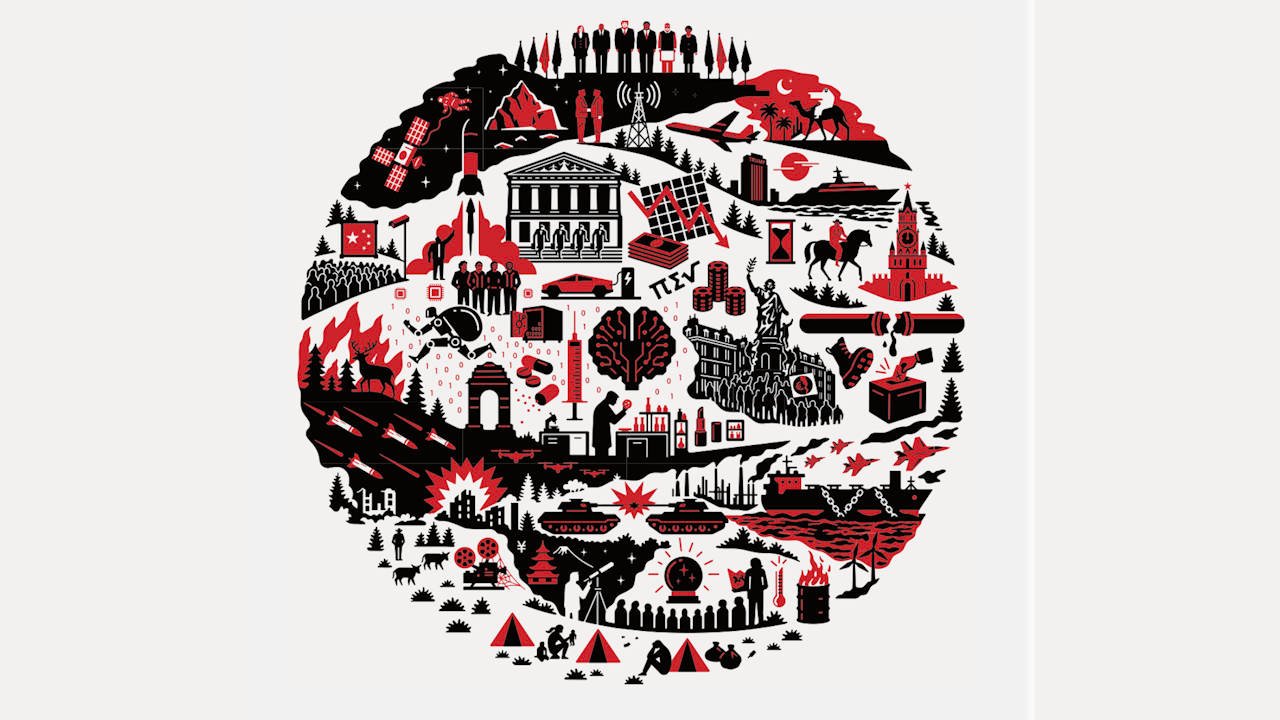
- The Economist’s new “The World Ahead 2027” cover, drawn by Cleon Peterson, went viral within hours. It is a red, black and white illustration packed with dozens of small symbols.
- The magazine says the cover matches its articles. It is a list of ten trends to watch, not a secret prophecy, and the “2027 cover” that circulated in September was an AI fake.
- Two of the ten trends hit your wallet directly: rising government borrowing costs and a possible crash tied to heavy AI-company debt.
- The 10-year Treasury yield closed at 5.12% on Nov. 16, and the average 30-year mortgage was 7.11% last week. That is the real-world version of the cover’s warning.
Every November, The Economist publishes a busy, slightly ominous illustration, and every November the internet decides it knows what it means. This year’s version showed up on Monday night, and by Tuesday morning people were calling it a map of 2027’s disasters. The more useful question is what it actually says, and whether any of it should change what you do with your money.
What the cover shows
The cover belongs to The World Ahead 2027, the magazine’s annual forecasting issue. The illustration is by the American artist Cleon Peterson, credited on The Economist’s own post on X. We aren’t reproducing the image here because it is the magazine’s copyrighted work, but you can see it at that link or on the Economist Group press page.
Here is how outlets that studied it describe it. The artwork is a flat, round “world” in just three colors: red, black and white. The title sits in black capital letters, with six short lines underneath: “Trump’s final chapter,” “Artificial intelligence,” “After Iran,” “Climate change,” “Populism on the rise” and “Hollywood reboots,” according to APAR.TV.
Inside the circle there is a lot going on. There is a tower with the word “Trump” on it, next to a yacht and an hourglass. There is a podium of figures in suits, a desert with a camel and a crescent moon, a broken pipeline and a chained oil tanker. A brain made of circuits sits in the middle, and a humanoid robot runs past with a sack over its shoulder, next to an open safe full of ones and zeros. Elsewhere you can spot missiles and tanks, a falling chart with banknotes and casino chips, a syringe and pills, a rocket, a wildfire, and a film projector covered in cobwebs. Reporte IDAA walks through these zone by zone. Mexican outlet Qpasa counts about 40 symbols in all.
The story behind it
The magazine has published a year-ahead edition since 1986, and the 2027 one is its 41st, according to Qpasa. The Economist Group’s announcement says it will be bundled with the weekly print edition dated Nov. 21, and sold on its own at newsstands from Nov. 26.
The argument comes from editor Tom Standage’s list of ten trends. They are: the post-Trump era, aftershocks from the Iran war, another record-hot year, a growing AI backlash, Europe’s populist right, pressure on bond markets, Taiwan, the “Ozempic effect” on consumer spending, cheaper space launches, and a Hollywood reboot.
The tone is blunt. Standage says Donald Trump won’t be a lame duck but “more like a destructive Angry Bird.” On AI, the magazine expects the danger of a crash to rise as AI firms take on more debt in “complex, opaque deals.” On rich countries’ finances, Standage is blunter still. As 77.today reports it, the conclusion is “Something, somewhere, has to break.”
Why everyone is talking about it
Part of it is just the design. A crowded drawing with no labels begs to be decoded. Brazilian fact-checkers at Aos Fatos say the covers have fed hundreds of “premonitions” in recent years, alongside The Simpsons.
The scale this time is large. Reporte IDAA says the magazine’s post of the cover passed 9 million views on X in 13 hours. Mexico’s El Universal reports that users on X and Instagram are treating it as an oracle, with claims about financial crises and wars. The most shared Spanish-language thread, per Qpasa, listed 24 “predictions,” some of which the magazine never mentioned. Aos Fatos found videos claiming the cover reveals a military intervention in Brazil and a Trump impeachment.
Then there are the fakes. In September, AAP FactCheck debunked a widely shared “2027 cover” with a birthday cake and a printed date range in January. The Economist confirmed to AAP that it was fake, and AAP’s check found an AI watermark on it. If you saw angels, trumpets or a red moon, that wasn’t the real thing.
The magazine’s own stance is deflating. Aos Fatos quotes the magazine as saying there is a simple, direct match between cover elements and the articles inside, and that its forecasts do miss sometimes. Standage’s launch tweet is a joke in the same spirit: modern life “can feel like being in a sci-fi story,” with only the aliens missing, and they “probably won’t appear in 2027.” Past covers show why caution makes sense. Reporte IDAA notes the 2020 issue was printed before the pandemic and didn’t see it coming.
What it could mean for your wallet
Skip the symbol-hunting. A few of the ten trends connect to everyday money. These are the magazine’s forecasts, not facts, so treat my takes as things to think about.
Borrowing costs. The bond-market warning is already visible. The Federal Reserve’s daily data show the 10-year Treasury yield at 5.12% on Nov. 16, up from 4.98% on Nov. 10. Mortgage rates tend to follow it. Freddie Mac’s latest survey has the 30-year fixed at 7.11%, down from 7.18% the week before but up from 6.24% a year ago, and that survey predates this week’s yields. If you carry a variable-rate balance or are shopping for a mortgage, the cover’s message and today’s numbers point the same way. See also our piece on the possible December Fed hike.
AI and your investments. The Economist thinks the risk of an AI-linked market crash is rising because of debt, while it says fears about AI wiping out jobs and data-center energy use “are not backed by data,” as 77.today and ForkLog quote Standage. If you own broad index funds in a 401(k) or IRA, a handful of AI-heavy companies can make up a big slice of them. Check your fund’s top holdings, but don’t panic, and don’t pile extra money into one hot sector because it’s in the news.
AI and security. The magazine also expects more capable AI models to power a wave of cyberattacks. The simplest defense is the boring one: turn on passkeys and two-step verification on your email and bank accounts.
Groceries and bills. The Economist says the Iran war and a “super El Niño” could threaten food security, with fertilizer in short supply. It doesn’t tell you what your grocery bill will do, and neither can I. But it’s another reason a cushion helps. If you haven’t built one, our guide to an emergency fund on a tight budget is a place to start.
Where people spend. One trend is more cheerful. The magazine expects people who lose weight on drugs like Ozempic to spend more on clothes, cosmetics and fitness.
The bottom line
The cover is a clever summary of what a very smart editorial team thinks will matter, drawn in a style that invites conspiracy theories. It isn’t a prophecy, and the magazine has said as much. What’s worth taking from it is simple: borrowing is getting pricier, AI is now a financial story as well as a tech one, and a bit of cash, a diversified portfolio and strong account security are sensible however 2027 turns out.
Sources
- The Economist Group: The Economist launches The World Ahead 2027 (Nov. 17, 2026)
- The Economist on X: cover post, credit to Cleon Peterson
- Reporte IDAA: Portada de The Economist 2027 (Nov. 17)
- APAR.TV: The World Ahead 2027, cover breakdown (Nov. 17)
- 77.today: The Economist’s World Ahead 2027 (Nov. 17)
- ForkLog: AI-sector leverage, sovereign debt top 2027 financial risks
- Qpasa: Portada de The Economist 2027 y sus 10 predicciones
- El Universal: Portada de The Economist 2027 enciende las redes (Nov. 17)
- Aos Fatos: ‘Economist’ revela nova capa e inicia mais uma onda de conspirações
- AAP FactCheck: Fake Economist cover spreads on social media (Sept. 10)
- Myth Detector: Fake versions of The Economist’s cover circulate on social media
- Federal Reserve Board: H.15 Selected Interest Rates (Nov. 17)
- Freddie Mac: Primary Mortgage Market Survey (Nov. 12)
This article is for general information only and is not financial advice. Consider your own situation or talk to a qualified professional before making money decisions.